
Professional employer organizations run on a strange kind of math. A PEO with 50 internal employees might be financially responsible for 3,000 worksite employees across a dozen client companies and eight legal entities. The HR software handles the people side. The accounting software has to handle everything else: payroll funding, intercompany transactions, client profitability, multi-entity consolidation, and the regulatory reporting that keeps a PEO’s certifications intact.
Most PEOs start this journey on systems like QuickBooks, but outgrow them quickly.
Where QuickBooks and on-premises systems break down
The PEO industry is sizable: between $136 and $156 billion in gross revenues, serving 156,000 to 180,000 small and mid-sized businesses, with 780 to 980 PEOs operating in the US. Most are running multiple legal entities, often a dozen or more, because state regulations and risk-pooling requirements practically demand it.
That structure creates an accounting problem most general ledgers weren’t built for. Every entity needs its own books, and each ne needs to talk to every other entity. And the production system PEOs run their operations on, usually PrismHR, handles client billing and HR workflows but has no general ledger at all (because it was never meant to).
The pattern shows up across nearly every PEO case study: a finance team logging in and out of separate QuickBooks instances for each entity, building consolidated financials by hand in Excel, and praying the numbers tie out.
Optimum Employer Solutions, a California-based PEO serving clients in 47 states, hit this wall as it added a third business entity. “We had to do all our consolidated financial statements in Excel, and it was not a good time to be had by anybody,” said Jenafer Elin, the company’s director of finance. Staff toggled between separate QuickBooks logins per entity and had no way to track profitability by client.
Nextep, an Oklahoma-based PEO with eight legal entities and 21 departments, ran into the same issue from a different angle. Its finance team spent two hours every day on duplicate journal entries across entities, plus hours more matching paper invoices, hand-coding general ledger accounts, and physically signing checks. Tandem HR described a monthly close spreadsheet with 56 tabs spanning three alphabets of columns. That’s what happens when entity count outpaces the software meant to track it.
What changes with Sage Intacct
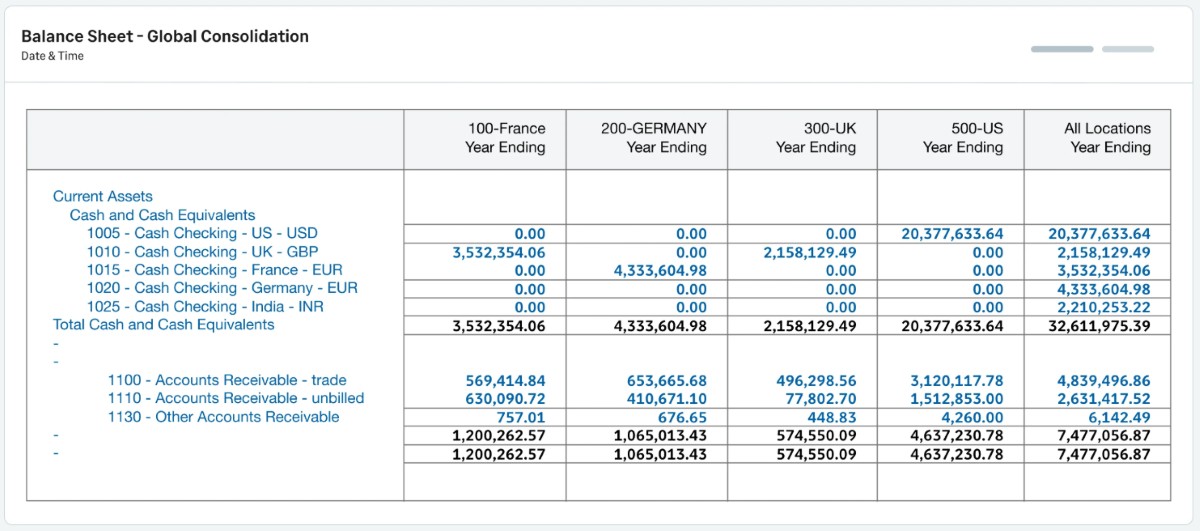
PEOs that move to Sage Intacct are solving one specific problem first: multi-entity consolidation that doesn’t require manual spreadsheet gymnastics. From there, the gains compound.
Time comes back fast. Optimum Employer Solutions eliminated up to 50 hours of manual accounting work each month and cut its monthly close time by a third. Nextep saved more than 500 hours of manual data entry a year and avoided adding headcount despite averaging 23% growth over three years.
Profitability becomes visible at the level that matters. Dimensional reporting lets PEOs slice data by client, location, region, insurance carrier, or service line, instead of digging through a flat chart of accounts. Nextep tracks gross profit per worksite employee and the ratio of worksite to internal employees by region, data it uses to decide where to expand. “We track important metrics like our gross profit per worksite employee,” said Ronda Rogers, Nextep’s controller. “This insight is critical, because it helps us determine how productive a particular region is from one month to the next.”
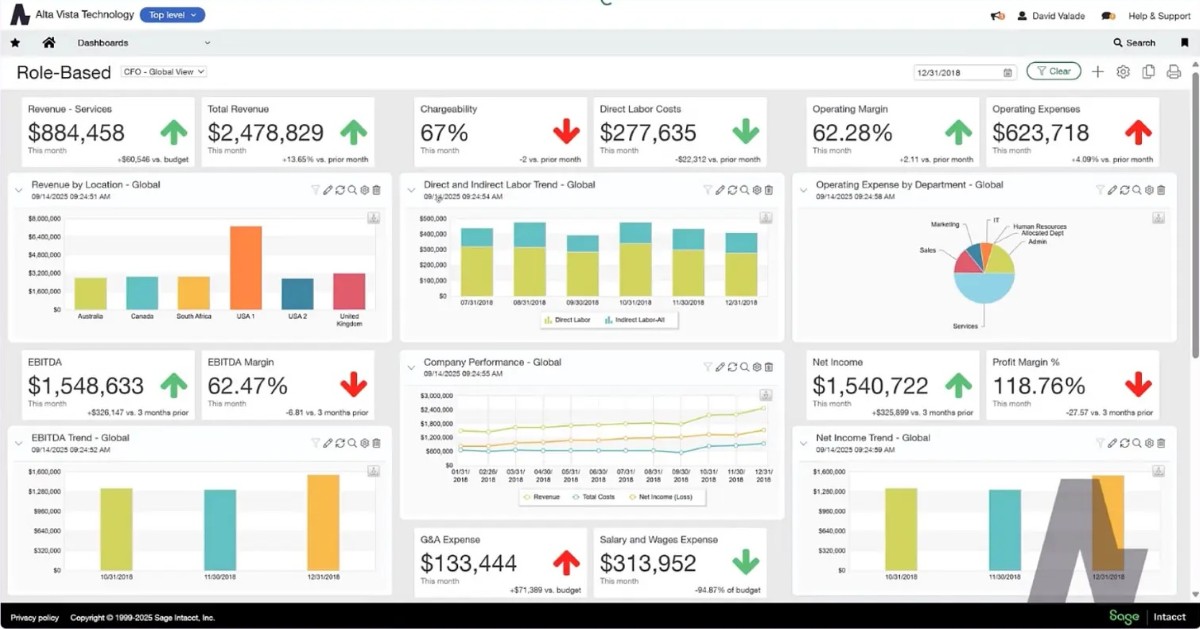
Executives stop waiting on reports. Both PEOs built dashboards that let leadership self-serve. Optimum’s CEO used to email the finance team for ad hoc reports; now he filters by client himself. Nextep’s leadership checks a monthly dashboard showing working forecast, balance sheet summary, and quarterly P&Ls against budget.
Compliance reporting stops being a special project. PEOs answer to bodies like the IRS, ESAC, NAPEO, and SPEA, each with its own quarterly reporting requirements. “All of the data we need to provide them is included on a quarterly dashboard,” Rogers said.
The PrismHR connection
Most PEOs run day-to-day operations, including client billing, on PrismHR. It’s not an accounting system and has no general ledger, so the data still has to land somewhere with real financial controls. PEOs on Sage Intacct typically push invoice data from PrismHR into Intacct for entity- and region-level P&L reporting, giving them one clean handoff point between the operational system and the books.
What this looks like at scale
The pattern holds whether a PEO has three entities or forty. Tandem HR, consolidating 21 entities, cut its annual close work by 500 hours through automated intercompany consolidation. INVO PEO, running 38 entities, gained 20 to 30% in productivity once profitability reporting moved out of Excel and into dimensional dashboards built by client, carrier, and state. The common thread is the moment a growing PEO realizes its accounting system has to scale, without needing another full-time hire just to keep the books straight.
A foundation that grows with the business
Growing PEOs are adding entities, entering new states, layering on services like project costing or recruiting, and absorbing regulatory change every year. The right financial system needs to handle multi-entity consolidation natively, integrate cleanly with HR production systems like PrismHR, and give every stakeholder, from controller to CEO, a dashboard that updates as invoices post, not a weekly report.
That’s where the right implementation partner sits alongside PEOs adopting Sage Intacct: configuring the system around how a co-employment business actually runs, not around a generic chart of accounts. The technology only pays off when it’s set up right the first time.
See what this looks like for your PEO
We help growing PEOs move away from costly manual workarounds, and onto Sage Intacct configured around co-employment accounting instead of a generic chart of accounts. If you're running multiple entities and want to talk through what that would mean for your close, your reporting, or your next state expansion, let's connect.

The right foundation for your next stage of growth
Our team of experts is here to help guide you every step of the way. Let’s start your ERP journey today!